Tag Archives: gardening

Best of friends – a quick guide to companion planting

My seedlings are all coming along nicely…they just need a bit more sunshine!

As well as my usual veg I have also planted loads of French marigold and sweet basil seeds to act as “companion plants”. I can’t remember where I first came across companion planting, but when I sat down to write this blog I checked my gardening books to see if I could pick up any interesting information or tips and was amazed at how little is actually written about this subject.

The internet is different, with everyone and their dog having an opinion about what is best. At the end of the day it all boils down to what you grow and where you live.

Companion planting is when you grow two or more types of plant closely together for mutual benefit.  There is a lot of talk about it being an organic method of pest control. I am not trying to be organic and would use chemicals as a last resort but as I am growing most of the “companions” anyway, why not just plant them where they will benefit another plant?

Most companion plants are strongly scented and confuse pests looking for their host plant. Others attract beneficial insects, such as ladybirds and lacewings, which prey on aphids. Some attract pollinators, like bees.

As I mentioned above, I grow marigolds and basil – these are my top 2 companion plants. I must admit I am not that keen on marigolds or their smell. I have flashbacks to the 1970s and tidy gardens edged with marigolds – the height of sophistication at the time! However, if you look at any list of suitable companions, marigolds appear the most.

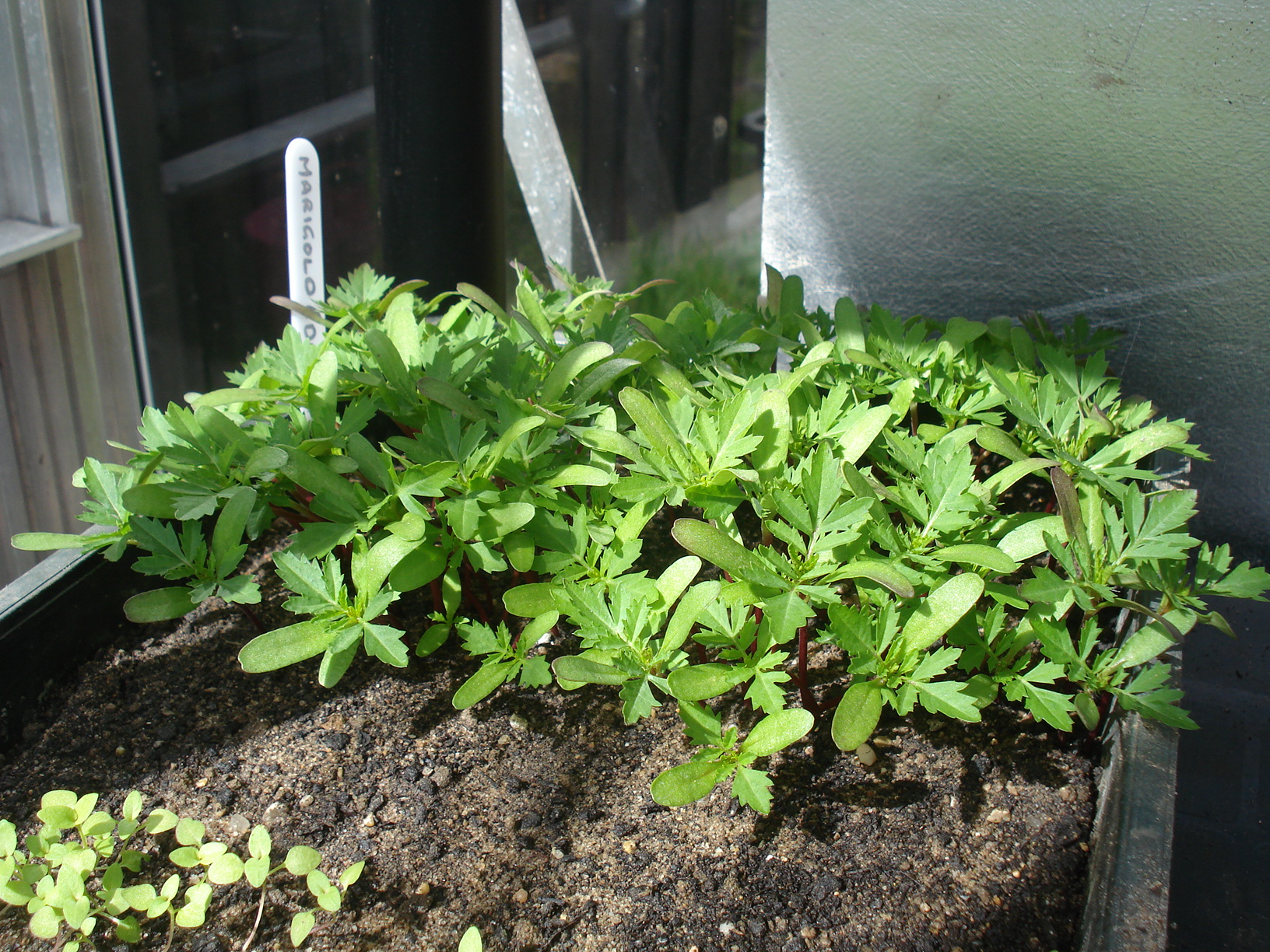
Marigolds ready for action!

I keep loads in the greenhouse and also plant them among my veg. The smell repels many insects. They also attract aphid eating hoverflies and keep whitefly away from tomatoes.

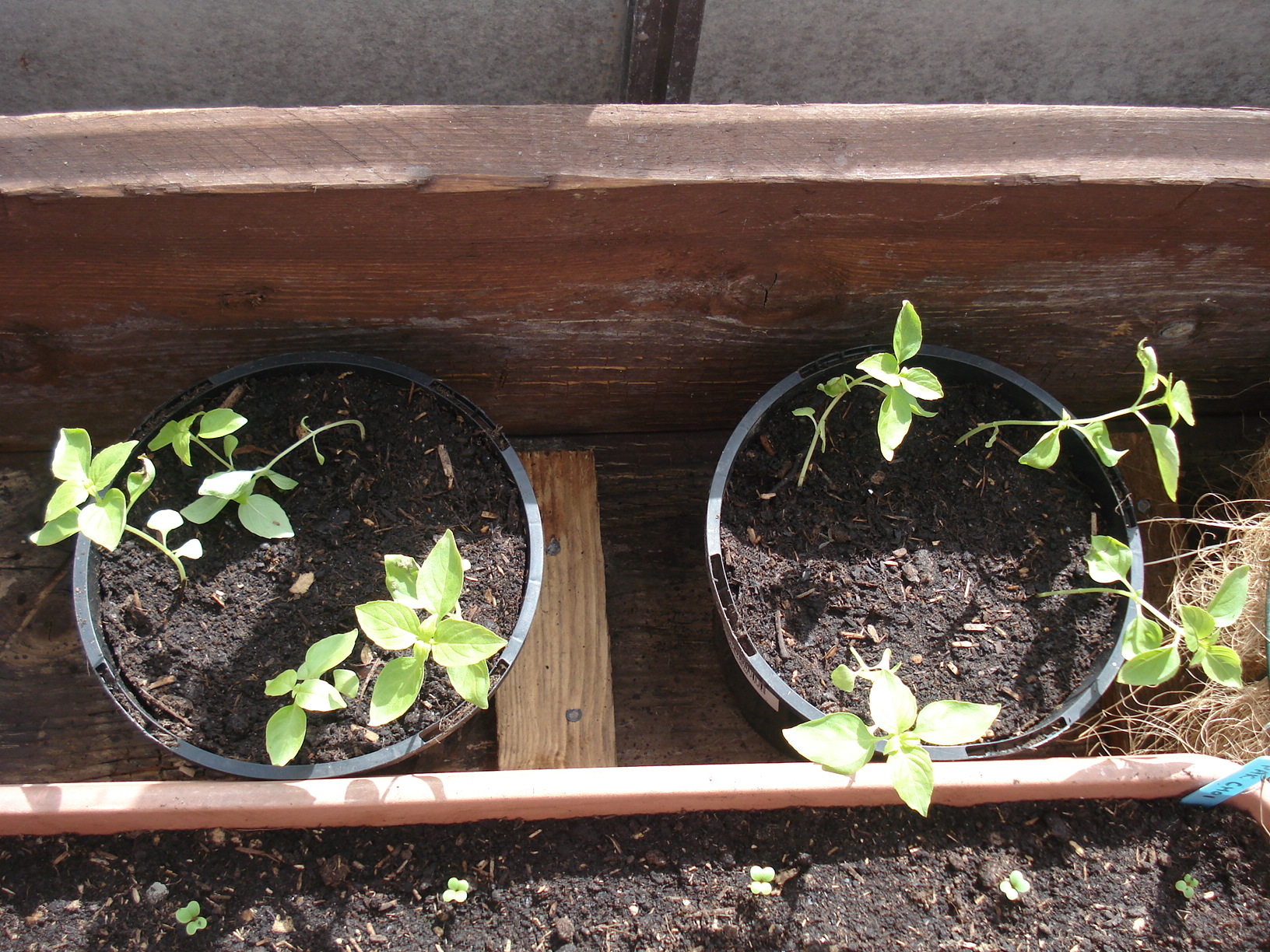
As for the basil I plant this between all my tomato plants as it is supposed to keep whitefly away. It is also perfect for picking at the same time as tomatoes for that classic combination! I have also learned that the shade provided by the tomato plants helps to stop the basil going to seed.
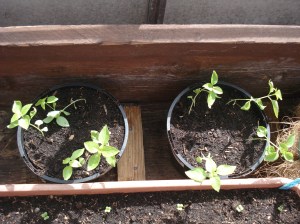
Basil coming along nicely!

Other top companions to try:

  • Garlic chive – when planted alongside carrots, its strong scent confuses and deters the carrot root fly, which can normally smell carrots from up to a mile away.
  • Lavender – attracts a range of pollinators, including bees, butterflies and hoverflies. Its strong scent can also deter aphids. Plant with carrots and leeks to confuse pests.
  • Sage – is strongly scented and will confuse pests of brassicas if planted alongside them. Its blue flowers attract bees and hoverflies, which also pollinate crops.
  • Thyme – makes a good companion plant for roses, as its strong scent deters blackfly. A tea made from soaking thyme leaves and sprayed on cabbages can prevent whitefly.
  • Nasturtiums – when planted with French and runner beans, the nasturtium acts as a sacrificial crop, luring aphids away from the beans. Its attractive flowers help attract beneficial insects, which prey on aphids.
  • Fennel – if left to flower it produces attractive yellow blooms that attract hoverflies, which prey on aphids.
  • Mint – the strongly scented leaves of mint confuse pests of carrots, tomatoes, alliums and brassicas, and deter flea beetles.

The combinations are endless and it depends what you are growing and what works for you. Last year my friend simply planted garlic beside everything she grew. This year, as well as the marigolds and basil, I am going to plant lavender among my leeks and sage between my brassicas.  It may all be an old wives tale but what is the worst that can happen?

Chives and mint
Lavender

Fingers crossed for a pest-free season!

Take the lettuce leaf challenge!

Now that the weather is (supposed to be) getting warmer, thoughts turn to salad rather than hearty, warming soups. However, it breaks my heart having to buy lettuce, especially when I know my own will be ready to start eating next month.

I was looking at the price of bagged lettuce in the supermarket. Prices range from 80p to £2.00. I go through a couple of bags a week  so if I spend an average of £3 per week on lettuce from April to September, that works out about £72!

(I do realise I could spend less on an actual lettuce and cut it up myself…but I’m lazy!)

Now I have never had much success growing whole lettuce, whether it be cos, little gem, iceberg or butterhead. However, lettuce leaves of the “cut and come again” variety, thrive.  I believe even the most neglectful gardener would find it hard to kill them off! You don’t even need a garden to do this.

For less than £10 you can have an endless supply of lettuce leaves on your windowsill, at your back door or in your greenhouse, all summer long. All you need are some pots, some multi-purpose compost, crocs for drainage and a selection of seeds.

I use Suttons “speedy veg” lettuce, some of which can be ready to eat in as little

"speedy veg" - ready in 3 weeks!

as 3 weeks, some rocket, spinach and perhaps lollo rosso for some colour. Make sure each packet of seeds contains around 500-1000 so it will last all summer.

Put some crocs (broken crockery or gravel) in the bottom of a pot and fill it with compost. Next, I get an egg cup and open each packet of seeds. Pour a little from each packet into the egg cup, mix together, then sprinkle over the surface of the compost, cover lightly with some more compost and water in.

In 3 to 4 weeks you can start picking and eating the leaves. The “cut and come again” type should last a few weeks so every 2 or 3 weeks sow another pot and by the time the first one is finished you will have a new pot all ready to tuck into.

I have used one side of a small growbag. These are the seeds I started last week. In a couple of weeks I'll sow some more in the other half of the growbag.

Keep the pots in a bright sunny place close to the kitchen.

Keep the compost moist, never let it dry out.

Keep a look out for slugs and snails.

Sow little and often .

Think of what you can buy with the money you’ll save!

Enjoy!

Recession friendly plant supports

In these times of austerity, it is alarming how much a quick trip to the garden centre can cost. All the bits, bobs and gadgets you think you need soon add up.

There are lots of ways to save money:

  • Our local garden centre has a 10% off day every Wednesday. You may only save a couple of pounds but over a whole summer of weekly trips this soon adds up to a substantial saving.
  • Larger chains also have some great deals and 10% off weekends. Keep a note of what you need and wait until you can get a discount.
  • Try growing your own flowers and veg from seed rather than buying plugs or garden ready plants. I calculated I saved over £180 by buying a packet of livingstone daisy seeds for £1.99.
  • Make your own compost.
  • Rather than buying cell trays for plants, save up yoghurt pot and tins, small and large and make some holes in the bottom.
  • Use the inside of a toilet roll for starting long rooted plants such as sweet peas or beans. The cardboard can be planted into the ground without disturbing the roots.
  • Subscribe to gardening magazines to save money on the cover price and benefit from the free packets of seeds they all seem to be giving away with each issue.
  • We have a local “freecycle” website where people advertise anything they want rid of. The purpose is to try to stop items being sent to landfill but quite often people will advertise excess plants or garden equipment they are giving away. It’s worth a look. I got rid of over 100 jerusalem artichoke tubers this way.
  • Look at what you have lying around that would do the same job. Instead of spending £6 on a dibber and dobber use a pencil and a fork!

Anyway, I digress.

This year we promised to make more of an effort to stake up all of our plants that need support. This means supporting plants as they are growing rather than sticking a bit of wire in the ground and wrapping some string around the plant when it is already lying at a jaunty 45 degree angle!

We have a clump of beautiful blue delphiniums and every year they just flower, then it rains and they fall over. They are about 12 inches tall at the moment, so bearing in mind our resolution to do the right thing by our tall plants I started to look at websites and magazines to see what kind of plant supports were available.

Let me tell you there is very little for under £10…and we need quite a few! Mr Mac promptly advised me there was no way he was spending £10 on some bent wire and disappeared off to his shed.

He came back with some lengths of wood (2×2 I am reliably informed), some fence paint, some fence wire, a pair of pliers and 2 screws.

This is how he did it


The wood was cut to the required length then painted with fence paint.

Dennis helped

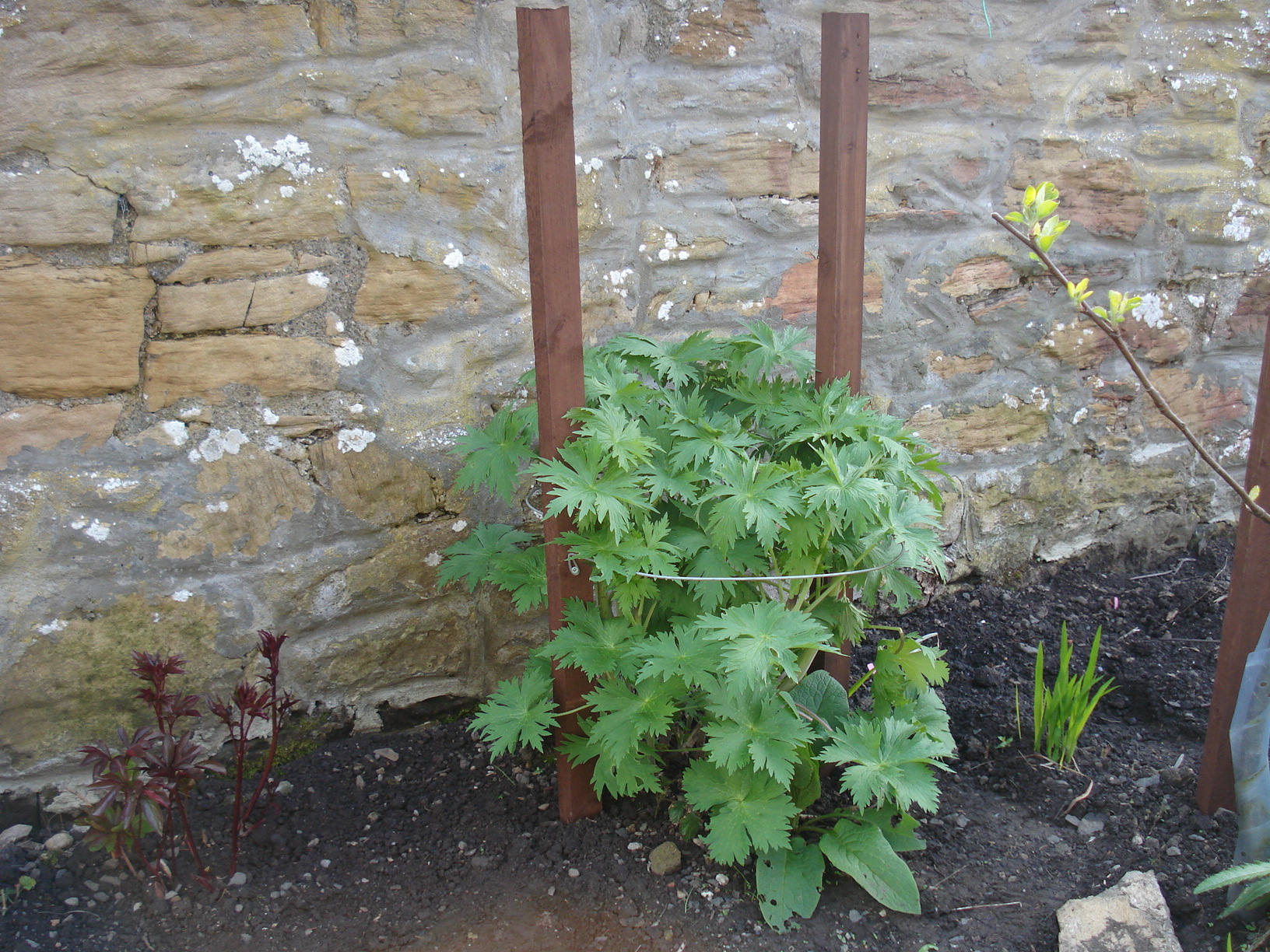
A stake was hammered into the ground either side of the delphiniums. They grow against a wall so no support was needed at the back. The fence wire was bent and each end looped with the pliers to allow the screws to fix the wire to the stake.

The finished article. As the plants grow they will cover the stakes and more wire can be attached to support them when they grow taller.

The plants will grow around the stakes so you will never see them. I was also impressed that Mr Mac has pre-prepared 2 more lengths of wire to attach to the stakes as the plants get higher. This is so he has no excuse for not adding support as the plants grow, defeating the purpose of have a support in the first place.

I asked Mr Mac what he thought his plant support cost. He worked it out and it cost less than £1!

Speedy compost and decoys

Well what a week it has been. I spent most of the time doing the greenhouse hokey kokey…in, out, in, out, have a cup of tea…trying to dodge the showers.

The good news…

It was time to turn the compost for the first time since creating the new bays. I timed Mr Mac and it took just over 30 minutes. A huge improvement on 2 years! He just used a fork and lifted the compost over into the empty bay. I ripped up some cardboard and threw it in too to add some carbon. I have also learned that adding cardboard can also stop the compost heap smelling! We shall see….

The middle bay was full and ready to be turned into the bay on the right.

30 minutes later..all done

All of the new waste is now on the bottom and lots of air has been introduced to help it break down quicker.

And the not so good news…

The pigeons got the blame for eating the chard and the tulips. However, we then noticed the rasberry canes had all been stripped of shoots and leaves up to a height of about 3 feet. There is no way pigeons could have done that. Perplexed, we spent the day building frames to support nets over the raspberries and at 5am the following morning, Mr Mac got up before any of the birds, set a trap and sat at the back door Elmer Fudd style…waiting.

Mr Mac

Do you know what it was?

It was the pheasant! He has been wandering around for a few weeks now but we had never seen him in the garden. He makes a very loud “caw, caw” noise, followed by flapping his wings so you can hear him, even if you can’t see him.

One morning he woke us up and I even joked that he was so loud it sounded as if he was at the bottom of the bed! That was probably the same morning he ate all the tulips!

Fear not! He is still alive and well but we are following his movements closely and if he comes anywhere near the garden he gets chased away.

We are still not convinced the pigeons are entirely without blame for all the damage. I watched a programme recently about the London Underground. They have so much bother from pigeons at depots and stations that they employ a hawk which scares away the pigeons.

I half joked to Mr Mac that perhaps we should get a hawk to scare away the pigeons. He told me I was a genius and went next door to see Wallace. His real name is John but I call him Wallace because he was the inspiration for Wallace and Gromit. He is always designing gadgets from bits and pieces lying around.

Anyway, this is what they came up with…

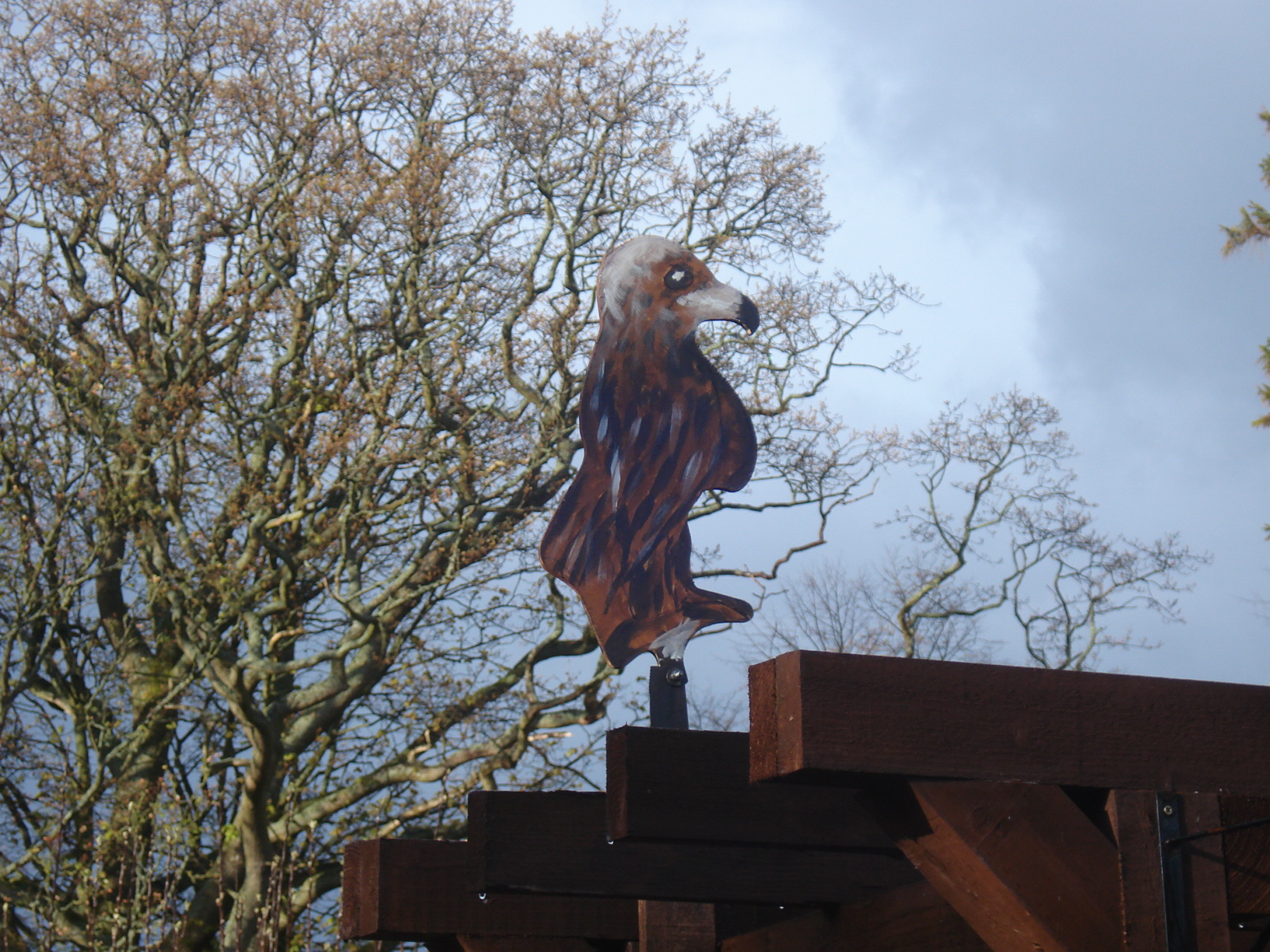
Our decoy hawk - terrifying!

He is made from plywood and is attached to a bendy bit of metal so he “wobbles” in the wind.  Wallace is currently designing some form of swivel mechanism.

Apparently, a second decoy was also produced but he looks more like tweety pie!

Something is eating my garden!

I went down to the greenhouse this morning to put my brassicas out in the sunshine to harden them off and noticed a couple of bulbs lying on the path. Then I followed the trail of destruction that led to 5 empty planters which, as of yesterday, were full of tulips just ready to open their flowers.

the flowers have been eaten right down to the soil and the bulbs pulled out!

Total devastation!

We had planned to move them into the front garden today but now there is nothing left.

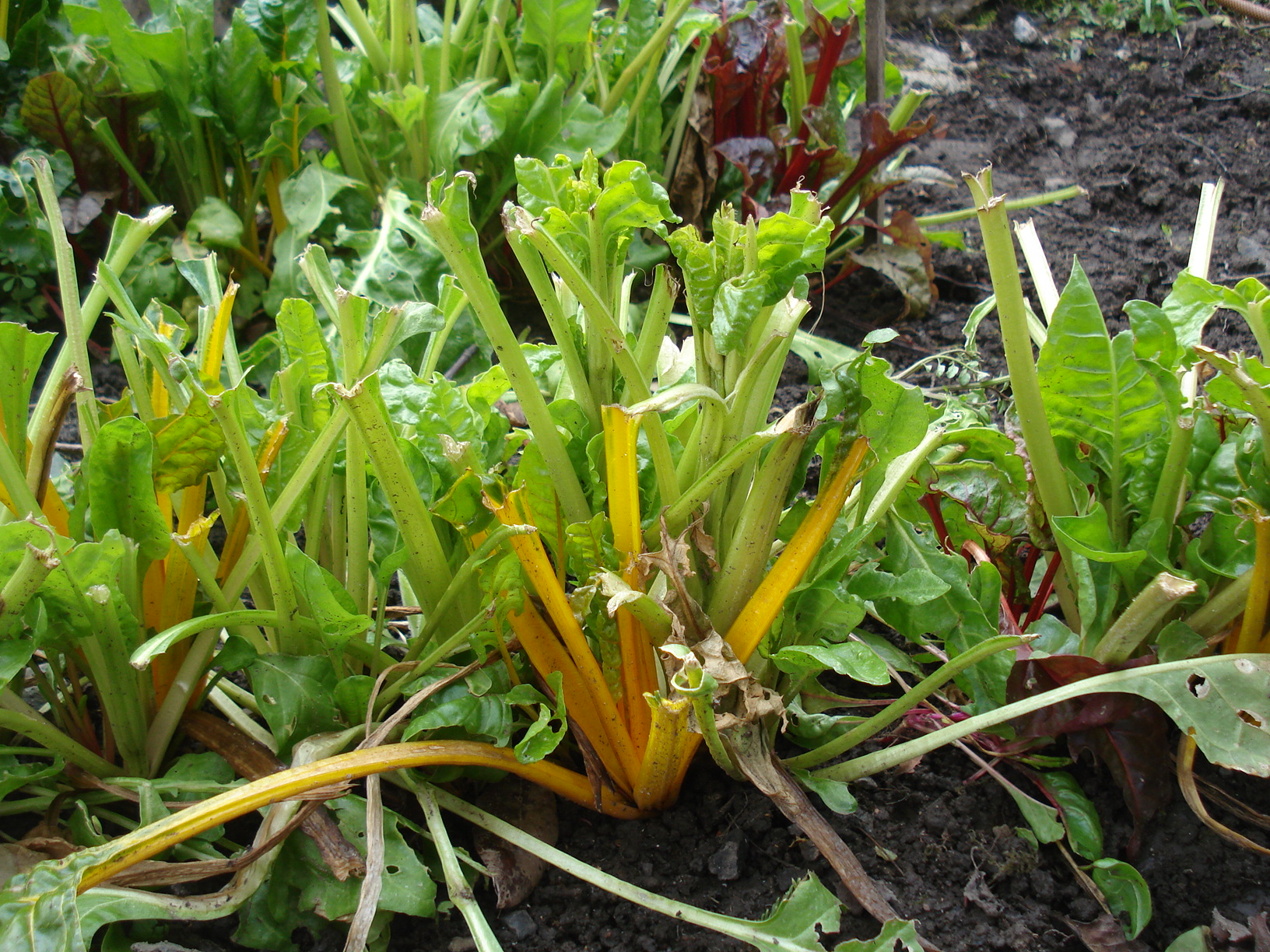
Earlier this week we also had to dig up 2 rows of rainbow chard which was also being eaten by something.

The chard, slowly getting nibbled

CHIEF SUSPECTS

Pigeons are the top suspects. I have noticed a lot of them flying around and sitting in the trees. The damage to the chard would indicate it was pigeons but I don’t see how they would be able to eat the tulip plants and be able to pull the bulbs out. We have not been bothered by pigeons before but then we have never grown chard or tulips before.

Rabbits are 2nd favourite. We are surrounded by fields which are full of rabbits although we are not usually bothered by them as we have two employees of the furry, four-legged variety who catch them. I could see the rabbits eating the chard but the tulips would be too high for them to reach – unless they carry a ladder!

The final suspect – deer. This year we have seen a record number of 7 deer in the fields beside us and they are becoming used to our presence, grazing right up to our fence. They eat grass, but do they eat tulips and chard? I don’t know.

Two outsiders

There is a fox which wanders around but we scare it away if it comes too close. Could he be a vegetarian? There is also a pheasant wandering around looking for a girlfriend – would he eat chard and tulips?

I am devastated about the tulips as we had looked after them all winter and they were going to produce a stunning display. That’s gardening for you though.

Thinking about it, something was attracted to the chard and after we pulled it out it has looked for the next best thing – tulips! Perhaps we should have left the chard as a decoy.

Here is one tulip that had come out. Really beautiful.

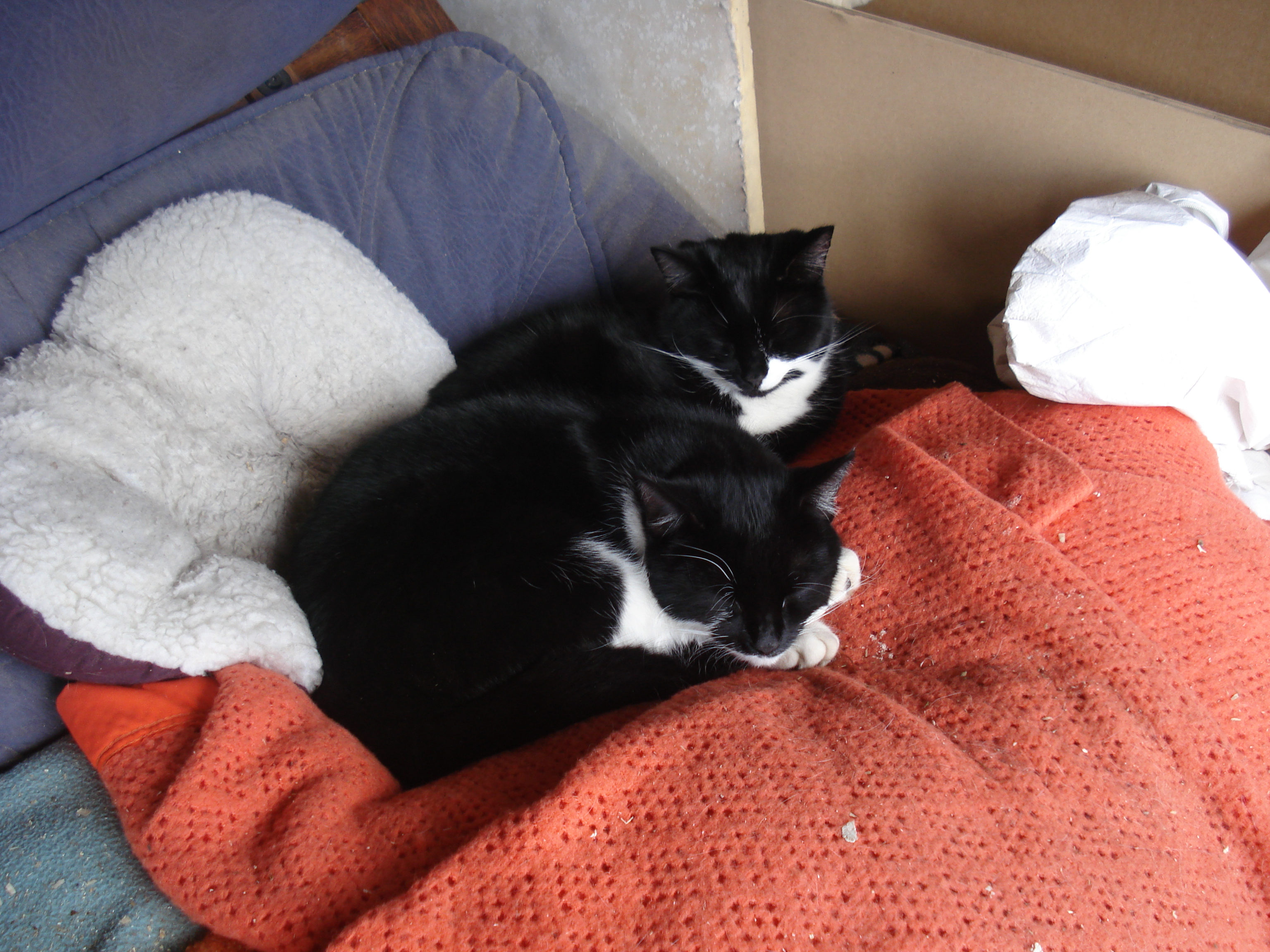
Could this be the reason why?

I am going to have to have a serious word with these two!

My favourite livingstone daisies

Our first few years at this house were spent renovating inside. The garden was neglected other than cutting the grass, some emergency tree surgery and seeing what plants we had inherited.

There was an overgrown bush in front of the kitchen window which blocked our view of the gate. It was also a jaggy bush and as Mr Mac has made it his mission to eliminate all things jaggy from the garden,  it was pulled out and burned.

This did leave us with a large area to fill and so off we went to the garden centre to buy a selection of bedding plants to give us some colour for the summer. After parting with £50 of his hard-earned cash Mr Mac announced that from then on I could grow my own flowers!

We bought a selection of livingstone daisies, calendula and zinnias and I fell in love with them all, especially the livingstone daisies. These are the flowers I chose for my blog banner at the top of the page.

Now some of you may have noticed that there has not been much actual gardening going on over the last week although I have (hopefully) been keeping you entertained with tales of broken pottery and growing chips. There is a reason for this. See below!

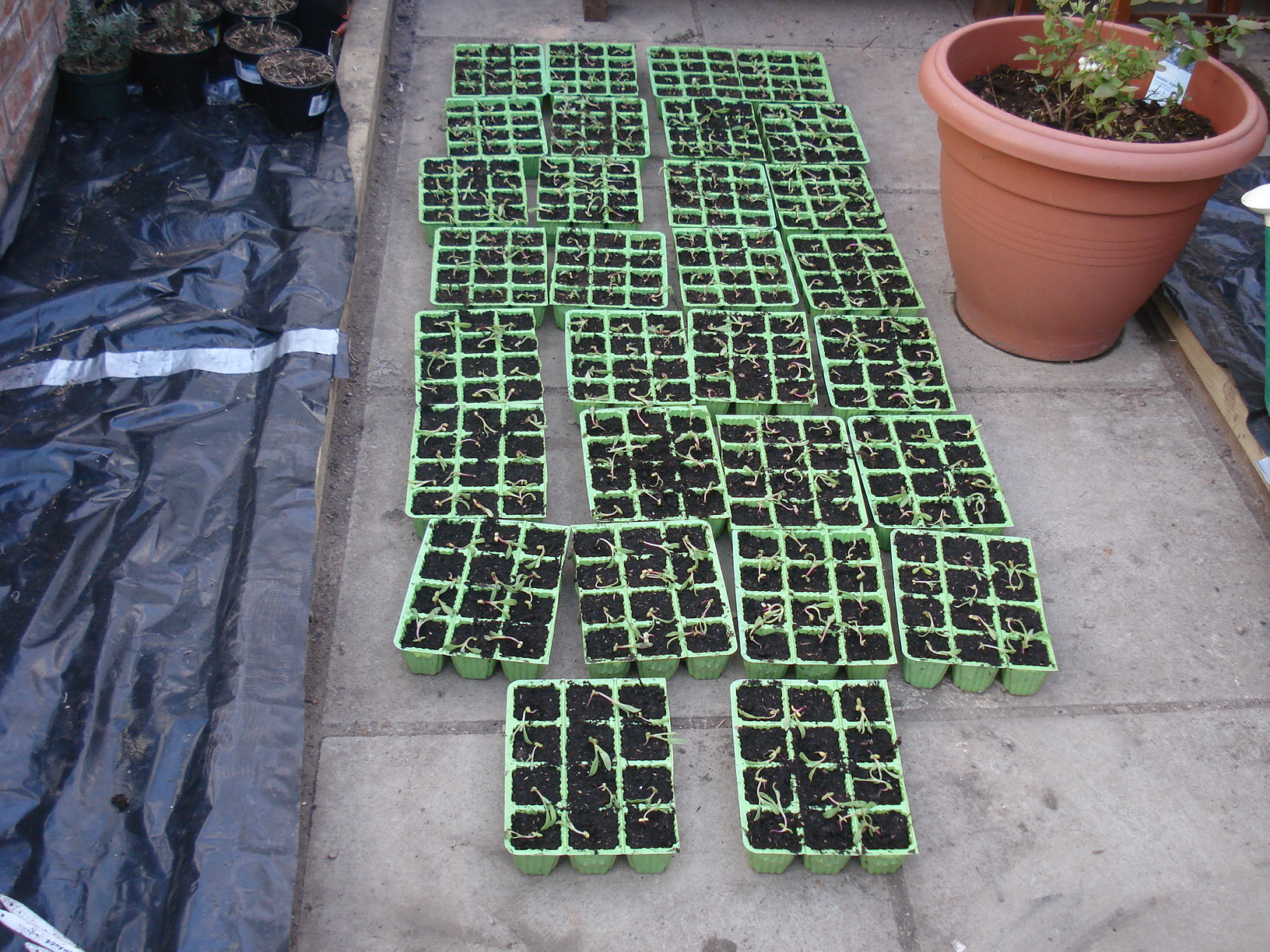
A victim of my own succcess! All of these little seedlings need a new home.

I planted a tray of livingstone daisy seeds and look at how they have germinated. I knew they were ready for potting on but I could not face it and kept putting it off. However, I had a word with myself yesterday, cleared a space in the greenhouse, put the radio on and got on with it.

There was a lot of wastage but in the end I stopped after 360!

360 livingstone daisies

I grow so many because we have several long borders and the daisies create a stunning display as well as provide good ground cover. I have also grown some to give to friends.

There were two things that kept me going. The first was knowing how fantastic they will look. When they open their wee smiley faces to the sun my heart just melts. The second was the fact that the garden centre sells 6 plants for £3. So I calculate that for a packet of seeds that cost £1.49 I have saved Mr Mac £180!

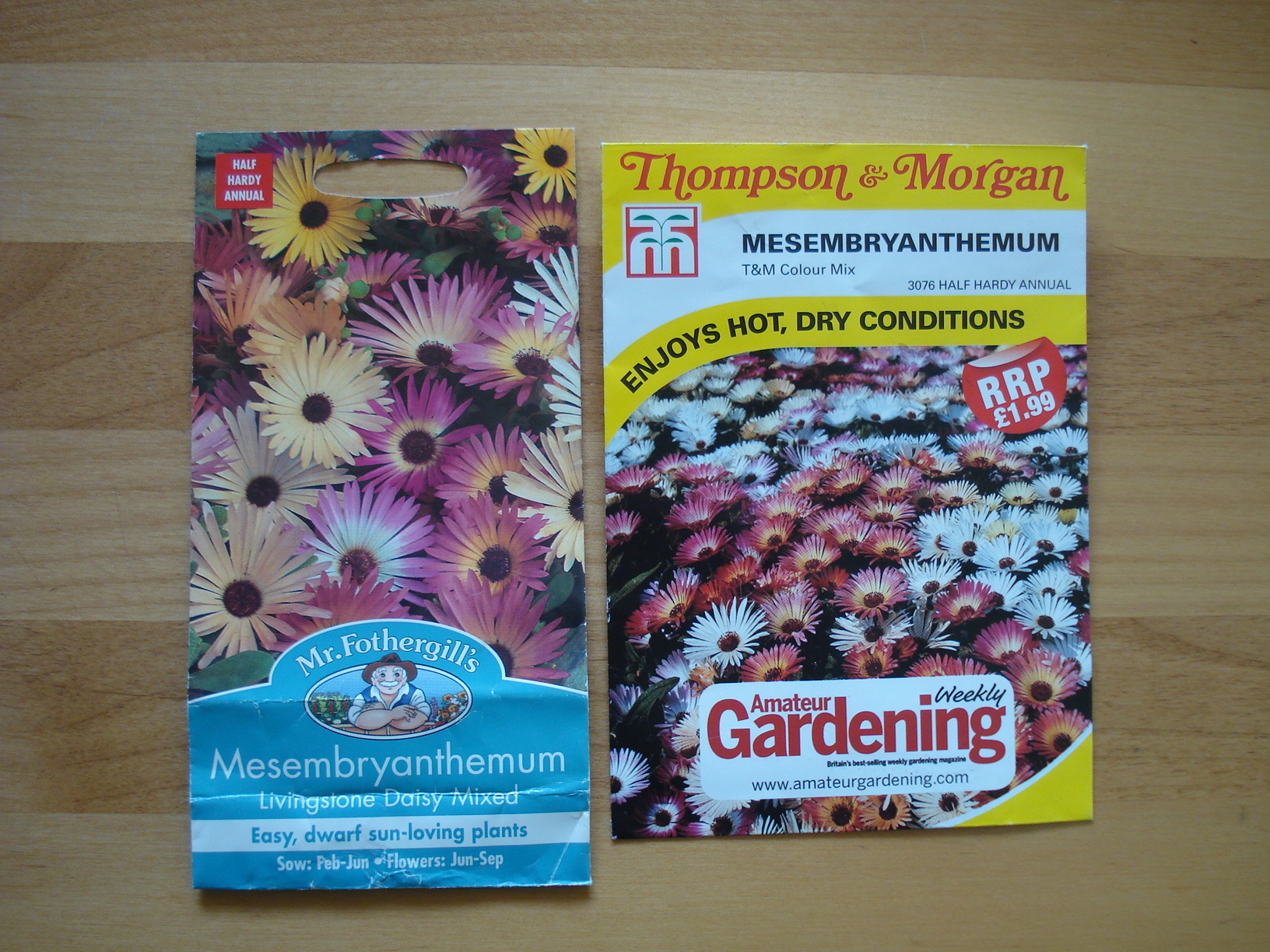
As a bonus this year I also got a free packet of livingstone daisy seeds with Amateur Gardening magazine (worth £1.99). They are a different variety but (thankfully!) have not germinated quite as successfully. They should be ready to pot on soon.

If you are tempted to grow some I promise you, you won’t regret it. They are perfect for the edge of borders and seem to be able to grow in any type of soil as long they are in a sunny spot.

Their “Sunday” name is Mesembryanthemum which means midday flowering. They are native to South Africa and are also known as fig marigolds or icicle plant.

This is what they looked like last year.

Mr Mac is growing chips!

One of the first things we did in our garden when we moved here was plant loads and loads of potatoes because they are good for breaking up the soil.  Mr Mac had experience of growing potatoes but when he started talking about seed potatoes, chitting, first earlies, second earlies, maincrop and haunching I realised there was slightly more to growing potatoes than I thought.

It sounded complicated and for a while I buried my head in the sand and just let Mr Mac get on with it. However, this year I decided to “face the fear” and work out what it is all about. After all, everyone else seems to be doing it so it can’t be that hard!

So here is my quick guide to growing potatoes:

  • Seed potatoes are not seeds but commercially cultivated tubers which you buy in bags from garden centres.
  • Potatoes are classified according to the length of time they spend in the ground. “Earlies” are ready for lifting first, then “second earlies” and in late summer, early autumn, “maincrop” varieties.
  • Potatoes will be ready to harvest sooner if the seeds are encouraged to develop shoots or sprouts before they are planted. This is known as “chitting”.
  • As potatoes grow, draw up earth around the stem so only the tip is exposed. This is known as “earthing up” or “haunching”.
  • First and second earlies are ready for harvesting when the plant flowers and the foliage is still green.  For maincrops, once the plant has gone brown and died completely, cut it down to ground level but leave the potatoes in the ground for another week. This allows skins to harden for storage.
  • Maincrop potatoes should be lifted on a dry day and left on the surface for a couple of hours to dry. They should be stored in a cool dark place in a hessian sack which allows moisture to evaporate.
  • Crop rotation is important.  Never plant potatoes in the same place two years running.

What we do

That first year we had so many potatoes we could have put McCain’s out of business! The purpose of growing so many was to break up the soil, which it did, but it also meant we were overrun with potatoes. We have never managed to store them successfully and the other major problem we had was worms. Probably 75% had been eaten by worms. We know worms are good for the soil which is fine as long as that is where they stay!

We had the same issue in year 2, even though we grew them in another part of the garden so Mr Mac decided all potatoes must be grown in a worm free zone. The solution? Compost bags turned inside out, a half whisky barrel and some deep pots.

We roll the compost bags down, put compost and one or two seed potatoes in the bottom and cover them. When the plant starts to grow, cover the stem and as more depth is required, just unroll the bag.

With the barrel and pots, the same applies. Start shallow and allow enough depth to keep adding compost until the potatoes are ready to harvest.

You can harvest one bag at a time by simply turning it out and collecting potatoes. There is no risk of stabbing the potatoes with a fork and they can be left in a quiet corner of the garden or kept inside and moved out once the risk of frost has passed. Easy!

Our favourites

This year we have planted a first early variety called “Foremost”. It will be ideal for new potatoes and salads. The other two varieties we love are both maincrops. Maris Pipers are good all-rounders and perfect for chips.  Pink Fir Apples have a pink knobbly skin, a waxy texture and nutty flavour, perfect with just some salt and butter mmmmmmmmmmmmmmmm.

Foremost first earlies being grown in a deep pot

The Foremost are well on the way.

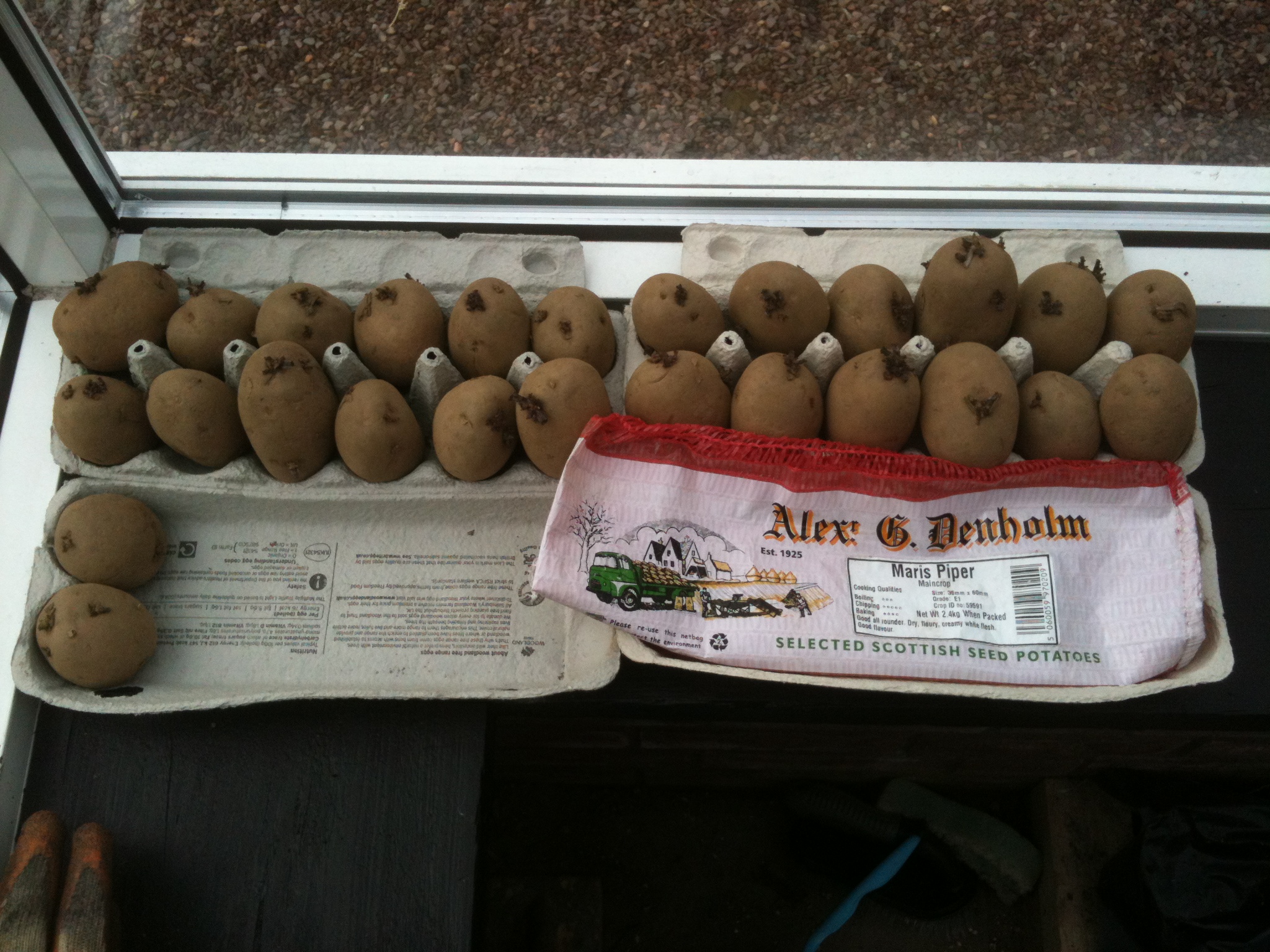
The Maris Pipers and Pink Fir Apples are happily chitting in the greenhouse.

Maincrops chitting away

And finally…….

Mr Mac has an acquaintance who told him about an ingenious method he had devised.  He did not have any growing space in his garden so he used old car tyres and just kept piling them up and filling them with compost as the plants got taller. Apparently his mother was moaning about the tyres making the garden look untidy and had told him they had to go. His reply was, “They can’t go. I’m growing my chips in them”!

The mystery of blue and white pottery

I have been digging and weeding like a demon trying to get the ground ready for planting – just as soon as spring returns (it is currently -4 degrees!).

Our house is built on the site of an old Victorian greenhouse which was demolished in the late 1980’s. The ground is full of smashed glass which we are always digging up. However, the other thing we keep coming across is bits of blue and white pottery.

the mysterious blue and white pottery

No matter where I have lived this seems to be a common occurrence and I started wondering where does it come from and why?

First port of call for any serious research – Google, of course. However, there is surprisingly little information on the world wide web about this phenomenon.

The only theory I could find is that in Victorian times the willow pattern was produced by every major pottery producer. It was produced on such a mass scale it was affordable to almost every Victorian household.

So how did it end up in gardens? Broken plates would be used as drainage in the bottom of pots in the garden and eventually contents would be tipped into the garden and ultimately buried…only to be dug up again in the 21st Century!

So in true Victorian spirit I will collect all the pieces of pottery I find and use them for drainage in my pots. Extreme recycling!

A little bit about herbs

Herb trough looking sorry for itself

Last year Mr Mac made me a herb trough from some old scaffolding boards he acquired. I painted it with some fence paint and planted lemon and golden thyme, marjoram, rosemary, parsley and chives.

I have just cleaned out the old leaves and twigs and given all the plants a tidy. I seem to have lost the marjoram though – it’s gone. The rest look quite woody and straggly but there is definitely new growth so hopefully they will all come back.

Then I remembered it’s Dougal’s Discount Wednesday at my local garden centre so I popped down and bought these new herbs – curry plant, lemon balm, roman chamomile, mint pineapple, chocolate peppermint and marjoram to replace the one I lost. Six plants for £9 plus Dougal’s 10% discount – a bargain!

I also grow ordinary mint but keep this in its own pot as it is very invasive. I have planted sweet basil and lemon basil seeds which I use for both cooking and as companion plants for the tomatoes and I might try growing coriander from seed – I am still thinking about it.

A funny story about coriander

A friend of Mr Mac’s brought us some chilli plants and herbs last year, one of which was coriander. Neither Mr Mac or myself are big fans of coriander (due to an incident in Goa in 1994!) but it was a gift and it seemed to grow quite happily in the greenhouse. Eventually I felt compelled to do something with it and as I had loads of carrots ready I decided on the old standard, carrot and coriander soup.

The soup was made and I tasted it and tasted it but no hint of coriander. I kept chopping it up and throwing in more and more but still not a hint of coriander.

At the time we had a heating engineer working on the stove in the kitchen and he fancied himself as a bit of a chef.  I asked him what he thought and where I was going wrong. He had a taste of the coriander and promptly killed himself laughing.The reason I could not taste the coriander was because it was flat-leaf parsley! The soup was still lovely, although very well garnished.

Lavender

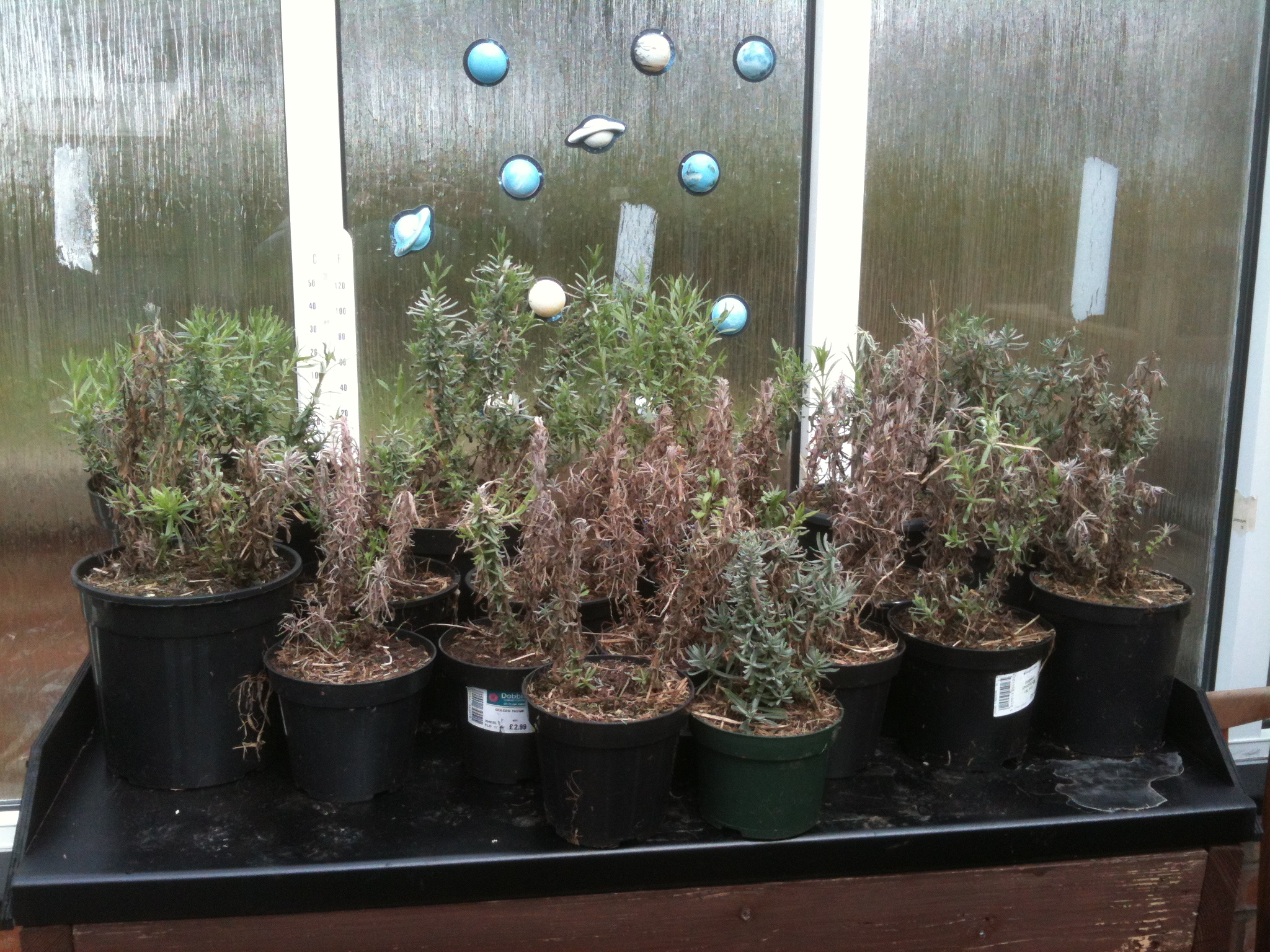
Last year I tried growing  lavender from seed. The lavender was successful and it even flowered at the end of the summer. I had plans for a lavender hedge beside the deck where we sit on sunny evenings but I was so precious about planting it out and losing it over the winter that I left it in the greenhouse. Mr Mac covered it all in straw to protect it and it seems to have survived.

Fortunately, this week’s issue of Amateur Gardening magazine has a section on pruning shrubs. Apparently the lavender should have been pruned after it flowered last summer. This allows time to develop new shoots which will carry buds for this year’s flowers.

It does say that any old, dead flowering stems should be cut out but not to cut into old wood. This is where I get confused and I do not know what that means. Some of my plants look as if they are dead. Others are partly dead but with lots of new leaves and a couple are full of new growth. I can’t work out what is “old wood” and “new wood” though.

So this is what I have done. I cut off all the old dead bits right down to the base. Where there was a dead stem but with new leaves at the end, I cut off about a third of the new growth. Where the whole stem was new growth, I cut off about a third. I hope I have not damaged or killed them. I will wait a few weeks and if they look alright I will plant them out. I have sown some more seeds this year, just in case.

Here is what they looked like before and after!

Before pruning

After pruning