Monthly Archives: April 2012

The easiest rice pudding ever!

I love rice pudding but I always felt the amount of effort was not worth it (I must have a rubbish recipe).

Recently, we were having friends over for dinner, one of who was dairy and gluten intolerant. This caused my brain to ache slightly. Our brief was to stick to vegetables and rice (I forgot to mention they were both vegetarian). My first instinct was rice pudding but then I realised it was full of cream, butter and milk which were off the menu!

One evening Mr Mac and I had a thai curry for dinner. I always misjudge the amount of sticky rice to make (the instructions on the side of the packet are in cups – I think I use mugs!) and we end up with enough to eliminate third world famine. The other annoying thing is we only ever use half a tin of coconut milk. The other half goes in the fridge and then gets thrown out after a month when I find it again!

Can you see where I’m going with this? Mr Mac suggested trying to make a rice pudding using the leftover rice and coconut milk.  It took us a while to get it right but we impressed our friends and now feel smug about not wasting food.

It is worth playing around with it to suit your own taste but this is what we do:

Ingredients (for 2 people)

  • Rice – whatever the packet suggests for a portion per person. We have used pudding rice and also leftover thai sticky rice and both work equally well.
  • 200ml (or half a tin) of coconut milk
  • 3 tablespoons of brown sugar (or to taste)
  • 1 vanilla pod
  • 3 or 4 cardomams
  • sliced mango for a garnish

Method

  1. Cook the rice as per instructions on the packet, drain and leave in a bowl.
  2. Put the coconut milk, sugar, cardomams (I bash them to get the seeds out but put the whole lot in the pan ) and vanilla pod (slice it open to release the seeds but put the whole lot in the pan) in a pan and warm through gently until all the flavours have infused into the milk.
  3. Once you are happy with the taste of the milk, strain it through a sieve over the rice. WARNING do not do what I once did and strain the milk over the sink only realising what a prize idiot I was when the last of the milk disappeared down the plughole!
  4. Mix the rice and milk together and eat straight away or leave until later and warm it up in the oven. Some sliced mango over the top finishes it off nicely.

You can mess around with other spices like cinammon or add nuts, and orange and lemon zest.

The beauty of this dish is it can be eaten straight away, eaten cold or made well in advance of guests coming leaving you time to be an attentive host.

It is also naturally free from dairy, eggs, soy and gluten so can be eaten by virtually everyone (unless you don’t like rice or coconut).

Enjoy!

My favourite livingstone daisies

Our first few years at this house were spent renovating inside. The garden was neglected other than cutting the grass, some emergency tree surgery and seeing what plants we had inherited.

There was an overgrown bush in front of the kitchen window which blocked our view of the gate. It was also a jaggy bush and as Mr Mac has made it his mission to eliminate all things jaggy from the garden,  it was pulled out and burned.

This did leave us with a large area to fill and so off we went to the garden centre to buy a selection of bedding plants to give us some colour for the summer. After parting with £50 of his hard-earned cash Mr Mac announced that from then on I could grow my own flowers!

We bought a selection of livingstone daisies, calendula and zinnias and I fell in love with them all, especially the livingstone daisies. These are the flowers I chose for my blog banner at the top of the page.

Now some of you may have noticed that there has not been much actual gardening going on over the last week although I have (hopefully) been keeping you entertained with tales of broken pottery and growing chips. There is a reason for this. See below!

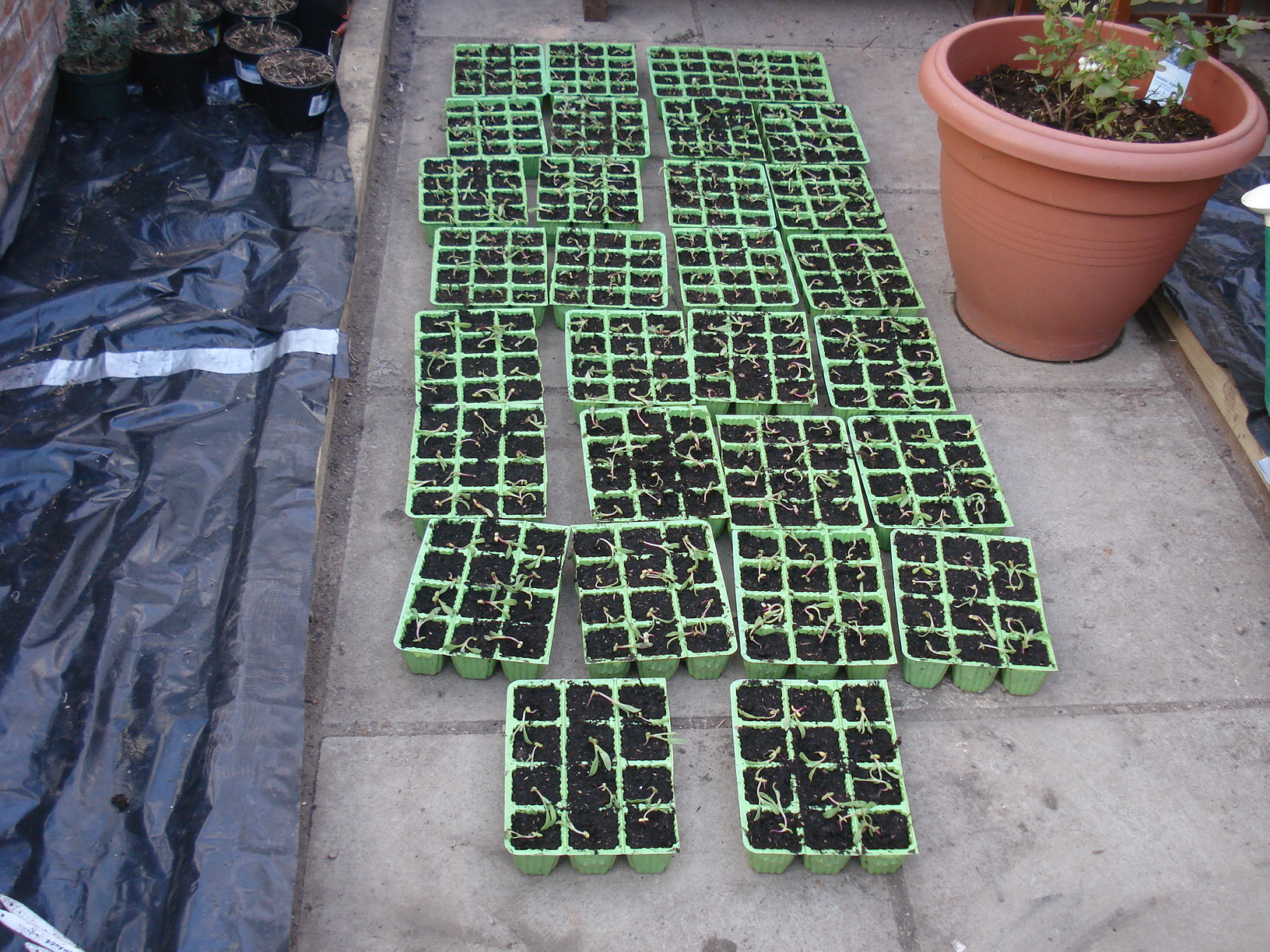
A victim of my own succcess! All of these little seedlings need a new home.

I planted a tray of livingstone daisy seeds and look at how they have germinated. I knew they were ready for potting on but I could not face it and kept putting it off. However, I had a word with myself yesterday, cleared a space in the greenhouse, put the radio on and got on with it.

There was a lot of wastage but in the end I stopped after 360!

360 livingstone daisies

I grow so many because we have several long borders and the daisies create a stunning display as well as provide good ground cover. I have also grown some to give to friends.

There were two things that kept me going. The first was knowing how fantastic they will look. When they open their wee smiley faces to the sun my heart just melts. The second was the fact that the garden centre sells 6 plants for £3. So I calculate that for a packet of seeds that cost £1.49 I have saved Mr Mac £180!

As a bonus this year I also got a free packet of livingstone daisy seeds with Amateur Gardening magazine (worth £1.99). They are a different variety but (thankfully!) have not germinated quite as successfully. They should be ready to pot on soon.

If you are tempted to grow some I promise you, you won’t regret it. They are perfect for the edge of borders and seem to be able to grow in any type of soil as long they are in a sunny spot.

Their “Sunday” name is Mesembryanthemum which means midday flowering. They are native to South Africa and are also known as fig marigolds or icicle plant.

This is what they looked like last year.

Mr Mac is growing chips!

One of the first things we did in our garden when we moved here was plant loads and loads of potatoes because they are good for breaking up the soil.  Mr Mac had experience of growing potatoes but when he started talking about seed potatoes, chitting, first earlies, second earlies, maincrop and haunching I realised there was slightly more to growing potatoes than I thought.

It sounded complicated and for a while I buried my head in the sand and just let Mr Mac get on with it. However, this year I decided to “face the fear” and work out what it is all about. After all, everyone else seems to be doing it so it can’t be that hard!

So here is my quick guide to growing potatoes:

  • Seed potatoes are not seeds but commercially cultivated tubers which you buy in bags from garden centres.
  • Potatoes are classified according to the length of time they spend in the ground. “Earlies” are ready for lifting first, then “second earlies” and in late summer, early autumn, “maincrop” varieties.
  • Potatoes will be ready to harvest sooner if the seeds are encouraged to develop shoots or sprouts before they are planted. This is known as “chitting”.
  • As potatoes grow, draw up earth around the stem so only the tip is exposed. This is known as “earthing up” or “haunching”.
  • First and second earlies are ready for harvesting when the plant flowers and the foliage is still green.  For maincrops, once the plant has gone brown and died completely, cut it down to ground level but leave the potatoes in the ground for another week. This allows skins to harden for storage.
  • Maincrop potatoes should be lifted on a dry day and left on the surface for a couple of hours to dry. They should be stored in a cool dark place in a hessian sack which allows moisture to evaporate.
  • Crop rotation is important.  Never plant potatoes in the same place two years running.

What we do

That first year we had so many potatoes we could have put McCain’s out of business! The purpose of growing so many was to break up the soil, which it did, but it also meant we were overrun with potatoes. We have never managed to store them successfully and the other major problem we had was worms. Probably 75% had been eaten by worms. We know worms are good for the soil which is fine as long as that is where they stay!

We had the same issue in year 2, even though we grew them in another part of the garden so Mr Mac decided all potatoes must be grown in a worm free zone. The solution? Compost bags turned inside out, a half whisky barrel and some deep pots.

We roll the compost bags down, put compost and one or two seed potatoes in the bottom and cover them. When the plant starts to grow, cover the stem and as more depth is required, just unroll the bag.

With the barrel and pots, the same applies. Start shallow and allow enough depth to keep adding compost until the potatoes are ready to harvest.

You can harvest one bag at a time by simply turning it out and collecting potatoes. There is no risk of stabbing the potatoes with a fork and they can be left in a quiet corner of the garden or kept inside and moved out once the risk of frost has passed. Easy!

Our favourites

This year we have planted a first early variety called “Foremost”. It will be ideal for new potatoes and salads. The other two varieties we love are both maincrops. Maris Pipers are good all-rounders and perfect for chips.  Pink Fir Apples have a pink knobbly skin, a waxy texture and nutty flavour, perfect with just some salt and butter mmmmmmmmmmmmmmmm.

Foremost first earlies being grown in a deep pot

The Foremost are well on the way.

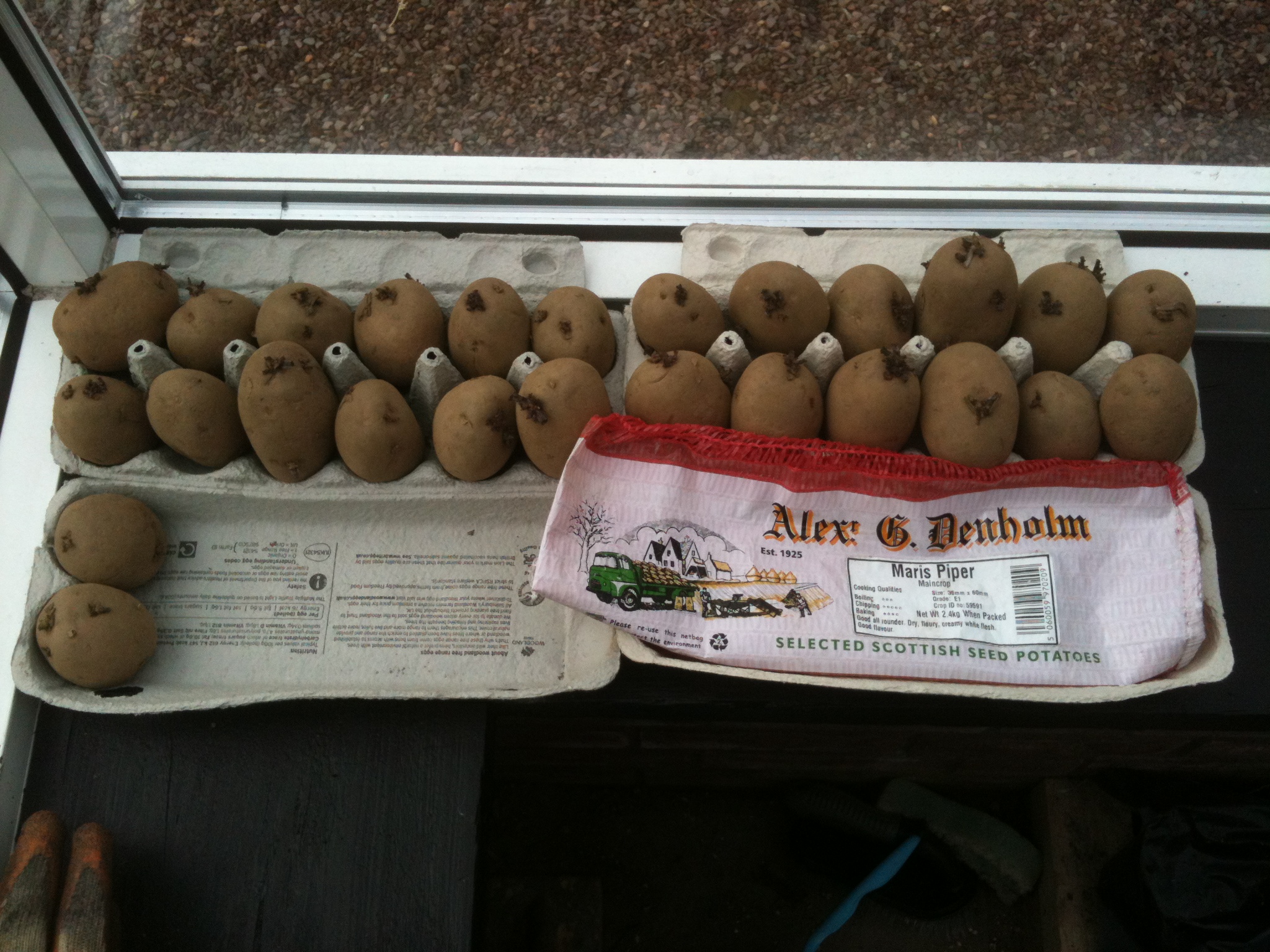
The Maris Pipers and Pink Fir Apples are happily chitting in the greenhouse.

Maincrops chitting away

And finally…….

Mr Mac has an acquaintance who told him about an ingenious method he had devised.  He did not have any growing space in his garden so he used old car tyres and just kept piling them up and filling them with compost as the plants got taller. Apparently his mother was moaning about the tyres making the garden look untidy and had told him they had to go. His reply was, “They can’t go. I’m growing my chips in them”!

Disaster has struck!

I knew it was cold last night as we had a thick white frost this morning and when I checked the temperature at 8am it was -4 degrees!

It never crossed my mind to look inside the greenhouses because, although it was cold, the frost would not get to the plants. However, I have just been out to check everything and I have lost quite a few plants. So far I have lost:

  • All Morning Glory plants – I was worried about these anyway as the leaves were becoming discoloured. All 18 are dead.
  • 68 Cosmos Plants
  • 14 Marigolds
  • 11 Sungold tomatoes
  • 9 Red Cherry tomatoes
  • 9 Moneymaker tomatoes

I am not so worried about the flowers as they all germinate quickly and will catch up. I am gutted about the tomatoes though. I planted them all on 19 February so they had a good head start. I have lost nearly 7 weeks but am going to have to start again.

The problem I have is that where I live in Central Scotland our summers can be mixed and are not famous for wall to wall sunshine. So if I have late tomatoes they will probably not get enough sunshine to ripen. This is why I always plant them so early so they get a head start and get the full benefit of any sunshine.

Now here is what I think I have done wrong. Last night I watered everything at 7pm. It was a clear night so the temperature (which was already low) would have plummeted very quickly. I think that even though the plants were protected from frost, the water must have frozen in the pots and modules and that is what has killed them. So from now on, or at least until there is no more risk of frost, I will water everything in the morning.

Not happy tomatoes

The mystery of blue and white pottery

I have been digging and weeding like a demon trying to get the ground ready for planting – just as soon as spring returns (it is currently -4 degrees!).

Our house is built on the site of an old Victorian greenhouse which was demolished in the late 1980’s. The ground is full of smashed glass which we are always digging up. However, the other thing we keep coming across is bits of blue and white pottery.

the mysterious blue and white pottery

No matter where I have lived this seems to be a common occurrence and I started wondering where does it come from and why?

First port of call for any serious research – Google, of course. However, there is surprisingly little information on the world wide web about this phenomenon.

The only theory I could find is that in Victorian times the willow pattern was produced by every major pottery producer. It was produced on such a mass scale it was affordable to almost every Victorian household.

So how did it end up in gardens? Broken plates would be used as drainage in the bottom of pots in the garden and eventually contents would be tipped into the garden and ultimately buried…only to be dug up again in the 21st Century!

So in true Victorian spirit I will collect all the pieces of pottery I find and use them for drainage in my pots. Extreme recycling!

A little bit about herbs

Herb trough looking sorry for itself

Last year Mr Mac made me a herb trough from some old scaffolding boards he acquired. I painted it with some fence paint and planted lemon and golden thyme, marjoram, rosemary, parsley and chives.

I have just cleaned out the old leaves and twigs and given all the plants a tidy. I seem to have lost the marjoram though – it’s gone. The rest look quite woody and straggly but there is definitely new growth so hopefully they will all come back.

Then I remembered it’s Dougal’s Discount Wednesday at my local garden centre so I popped down and bought these new herbs – curry plant, lemon balm, roman chamomile, mint pineapple, chocolate peppermint and marjoram to replace the one I lost. Six plants for £9 plus Dougal’s 10% discount – a bargain!

I also grow ordinary mint but keep this in its own pot as it is very invasive. I have planted sweet basil and lemon basil seeds which I use for both cooking and as companion plants for the tomatoes and I might try growing coriander from seed – I am still thinking about it.

A funny story about coriander

A friend of Mr Mac’s brought us some chilli plants and herbs last year, one of which was coriander. Neither Mr Mac or myself are big fans of coriander (due to an incident in Goa in 1994!) but it was a gift and it seemed to grow quite happily in the greenhouse. Eventually I felt compelled to do something with it and as I had loads of carrots ready I decided on the old standard, carrot and coriander soup.

The soup was made and I tasted it and tasted it but no hint of coriander. I kept chopping it up and throwing in more and more but still not a hint of coriander.

At the time we had a heating engineer working on the stove in the kitchen and he fancied himself as a bit of a chef.  I asked him what he thought and where I was going wrong. He had a taste of the coriander and promptly killed himself laughing.The reason I could not taste the coriander was because it was flat-leaf parsley! The soup was still lovely, although very well garnished.

Lavender

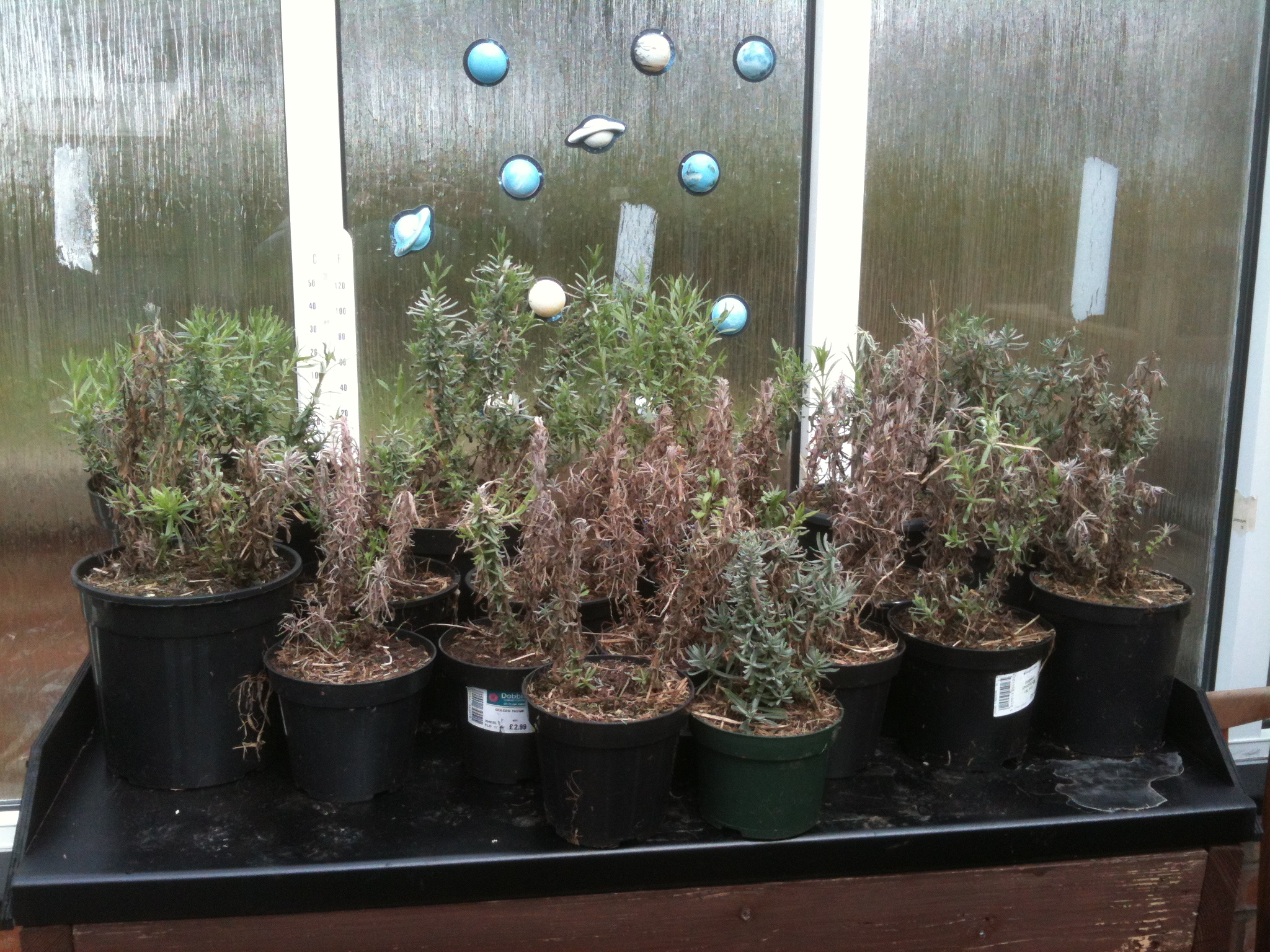
Last year I tried growing  lavender from seed. The lavender was successful and it even flowered at the end of the summer. I had plans for a lavender hedge beside the deck where we sit on sunny evenings but I was so precious about planting it out and losing it over the winter that I left it in the greenhouse. Mr Mac covered it all in straw to protect it and it seems to have survived.

Fortunately, this week’s issue of Amateur Gardening magazine has a section on pruning shrubs. Apparently the lavender should have been pruned after it flowered last summer. This allows time to develop new shoots which will carry buds for this year’s flowers.

It does say that any old, dead flowering stems should be cut out but not to cut into old wood. This is where I get confused and I do not know what that means. Some of my plants look as if they are dead. Others are partly dead but with lots of new leaves and a couple are full of new growth. I can’t work out what is “old wood” and “new wood” though.

So this is what I have done. I cut off all the old dead bits right down to the base. Where there was a dead stem but with new leaves at the end, I cut off about a third of the new growth. Where the whole stem was new growth, I cut off about a third. I hope I have not damaged or killed them. I will wait a few weeks and if they look alright I will plant them out. I have sown some more seeds this year, just in case.

Here is what they looked like before and after!

Before pruning

After pruning

Winter is back – so here is a great soup to keep you warm!

Lemon scented spicy chicken broth

I discovered this recipe just before Christmas last year and it is a great winter warmer, perfect for a cold day in the garden – especially days like today when it is snowing!

I would suggest making double the amount of infused stock and freeze half. That way you can rustle up a second batch in super quick time – especially if you have leftover roast chicken!

Ingredients

  • 1.5 litres chicken stock
  • 5cm peeled and chopped ginger root
  • 2 garlic cloves, peeled and sliced
  • Thinly pared zest of two lemons
  • 1 long red chilli, seeded and chopped
  • 200g leeks, washed and thinly sliced
  • 200g carrots, peeled and finely diced
  • 100g Arborio rice
  • 225g boneless, skinless cooked chicken breast, cut into small pieces
  • 2 tablespoons lemon juice
  • Salt and freshly ground black pepper

Method

  1. Place the stock, ginger, garlic, lemon zest and chilli into a large saucepan. Bring to the boil, cover and simmer for 30 minutes.
  2. Sweat the carrots and leeks in a little oil until the leeks have softened. Add the rice grains then strain over the infused stock.
  3. Bring to the boil and cook for 15 minutes, or until the rice is cooked.
  4. Add the chicken and the lemon juice, salt and pepper and cook gently for 5 minutes.
  5. Check seasoning and eat!

Gardening jobs for April

I have a great book called “allotment month by month” by Alan Buckingham which tells you what to sow, what to grow and jobs to do each month of the year.

As yesterday was 1 April 2012 I dutifully pulled the book down from the shelf and set about seeing what needed to be done.

Apparently April and May are know as the “hungry gap” months when there is a shortage of fresh vegetables and salad. Over-wintered crops have been eaten and this season’s new crops are nowhere near ready.

However, April is a good month for sowing seeds  indoors, in cold frames, under cloches or, if you’re super organised and have already warmed your soil, directly outdoors.

Top tasks for April

  • Harvest the first asparagus of the year along with spring cabbages, cauliflowers, sprouting brocolli and any remaining leeks and kale.
  • Plant second early and maincrop potatoes and onion sets.
  • Earth up first early potatoes.
  • Prepare seed beds by weeding thoroughly and raking over the soil.
  • Prune cherries and plums once leaf buds have opened.

I don’t have anything to harvest, Mr Mac is in charge of potatoes and onions and our cherry and plum trees were only planted last year so are too young to prune. So all that leaves for me to do is prepare the seed beds which I started yesterday.

However, this time last week it was 23 degrees and I was wearing shorts. I have just popped down to the bottom of the garden to check the thermometer and it is 5 degrees! What’s more, snow is forecast for this evening and tomorrow morning.

So the way I look at it, there are still another 28 days in April so there is no rush. I think I’ll have a cup of tea and sit in front of the fire for a while!